How to Choose the Best Flat Heat Pipe for Your Needs?
Choosing the right Flat Heat Pipe can be challenging. A variety of factors influence this decision. Understanding the specific requirements of your application is crucial.
Flat Heat Pipes provide efficient thermal management. They are often used in electronics, aerospace, and renewable energy systems. However, not all Flat Heat Pipes are suitable for every need. Differences in materials, dimensions, and thermal conductance can significantly impact performance.
Consider your environment and heat loads carefully. A well-chosen Flat Heat Pipe can enhance efficiency and product lifespan. Yet, a poor choice may lead to overheating or system failure. Research and expert advice can help make informed decisions. Seek reliable sources to guide your selection.
Understanding Flat Heat Pipes: Principles and Applications
Flat heat pipes are essential tools in thermal management. They effectively transfer heat using phase change principles. When liquid inside the pipe heats up, it vaporizes, creating movement. This process cools down heat sources quickly. Understanding this principle is crucial for selecting the right flat heat pipe.
Applications range from electronics cooling to solar thermal systems. In electronics, these pipes help manage high temperatures in compact spaces. In solar applications, they enhance the efficiency of heat absorption. However, choosing the best one can be challenging. Many factors influence performance, including material selection and design.
Despite their advantages, flat heat pipes have limitations. Factors like orientation and deployment conditions can impact effectiveness. Users often overlook these aspects during selection. It’s important to consider specific requirements thoroughly. Testing different configurations may lead to better results and prevent overheating issues.
Key Factors to Consider When Selecting a Flat Heat Pipe
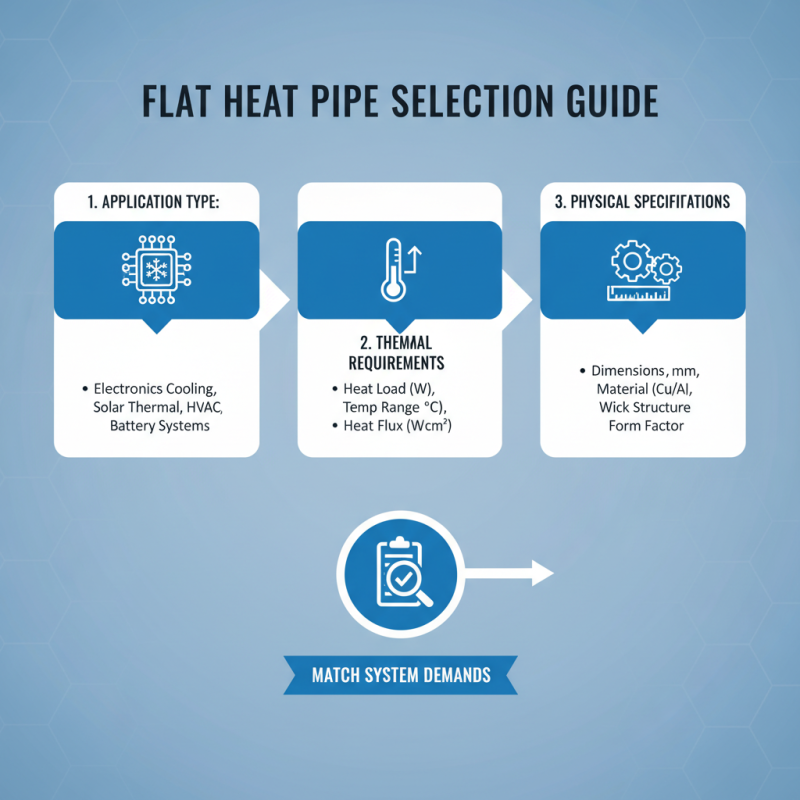
Choosing the right flat heat pipe involves several key factors. Firstly, you need to understand the applications. Flat heat pipes serve various industries, from electronics cooling to solar thermal energy. Each application has unique thermal requirements. It's crucial to match the heat pipe specifications with your system's demands.
Next, consider the materials used in the heat pipe. Common options include copper and aluminum. Copper offers excellent thermal conductivity but can be heavier. Aluminum, while lighter, may not perform as well in certain conditions. Analyzing your project's weight and performance criteria is essential.
Another factor is the operating temperature range. Different heat pipes can handle different temperature regimes. Ensure that the selected pipe can operate efficiently throughout your anticipated conditions. It's also important to consider manufacturing tolerances. A less precise product may lead to inefficiencies in thermal transfer. Always look for reliable suppliers that adhere to strict quality standards to ensure performance.
Comparing Different Materials Used in Flat Heat Pipes
When selecting flat heat pipes, materials significantly impact performance. Common options include copper, aluminum, and stainless steel. Each has unique thermal conductivity and weight properties that influence heat transfer efficiency. According to a report by the International Journal of Heat and Mass Transfer, copper offers the highest thermal conductivity at approx. 400 W/mK, while aluminum lags behind at 205 W/mK.
Consider the application environment. Copper may be ideal for industrial settings due to its performance. However, in corrosive conditions, stainless steel is superior. A study published by the Heat Pipe Conference indicates that aluminum is a lightweight and cost-effective alternative, though its lower thermal performance may be a trade-off in some applications.
Tips: Always assess thermal requirements. Look for a balance between durability and efficiency. Remember that diverse applications may require different materials. Don’t overlook the initial cost when calculating long-term savings. Pay attention to the overall system design, which can impact heat pipe performance. Testing in your specific conditions is crucial, as theoretical values often differ from real-world performance.
How to Choose the Best Flat Heat Pipe for Your Needs? - Comparing Different Materials Used in Flat Heat Pipes
| Material |
Thermal Conductivity (W/m·K) |
Weight (kg/m²) |
Operating Temperature (°C) |
Cost (USD/m²) |
| Copper |
400 |
8.96 |
-200 to 300 |
150 |
| Aluminum |
235 |
2.7 |
-50 to 150 |
90 |
| Graphite |
150 |
1.0 |
-200 to 2500 |
200 |
| Stainless Steel |
15 |
7.9 |
-20 to 800 |
300 |
Evaluating Thermal Performance Ratings of Flat Heat Pipes
When evaluating flat heat pipes, thermal performance ratings are critical. These ratings often highlight the efficiency of heat transfer. A reliable heat pipe can typically achieve thermal conductivities exceeding 30,000 W/m·K. This performance is essential in applications like electronics cooling and renewable energy systems.
The industry emphasizes the importance of the filling ratio. Optimal performance usually occurs with a filling ratio between 50% and 70%. However, too high or too low can hinder effectiveness. Minimal liquid in the pipe may lead to insufficient heat transfer. Conversely, excess liquid may cause flooding, reducing overall efficiency.
Understanding these ratings is essential in selecting a flat heat pipe. Data from recent studies indicate that heat pipes with higher thermal resistance may actually perform better in non-ideal conditions. This insight prompts reflection on how "ideal" often differs from real-world applications. Selecting the right heat pipe entails balancing these various factors to meet specific needs effectively.
Customization Options for Specific Heat Transfer Needs
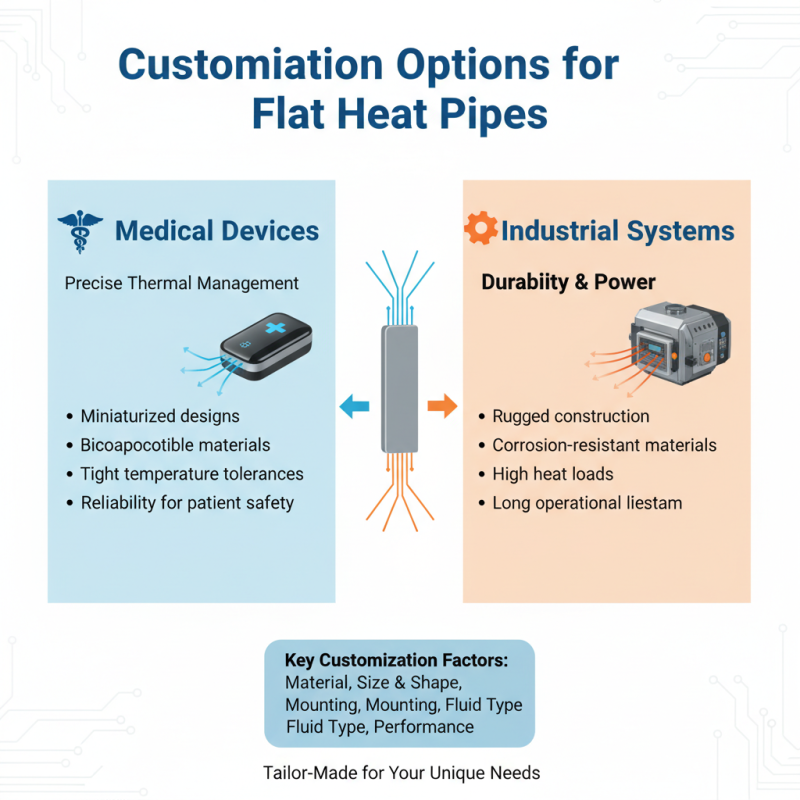
When selecting a flat heat pipe, customization is key. Different applications require unique specifications. For example, a medical device may need precise thermal management. Meanwhile, an industrial system may prioritize durability over size. Understanding your specific heat transfer requirements is crucial.
Consider the materials used in the heat pipe. Copper is excellent for high thermal conductivity, but other options may suit lower-cost applications. Dimensions are also important; compact designs are ideal for tight spaces, while larger profiles can dissipate heat more effectively. Customizing these elements can significantly enhance performance.
The working temperature range is another factor. Some applications may demand extreme temperature tolerance. In this case, the heat pipe design must accommodate those conditions. Testing under various scenarios can reveal shortcomings. Perhaps the heat pipe performs well at room temperature but struggles in high-heat situations. Such insights guide better design choices and improvements.









 Mr. Perry Wu International Sales Director